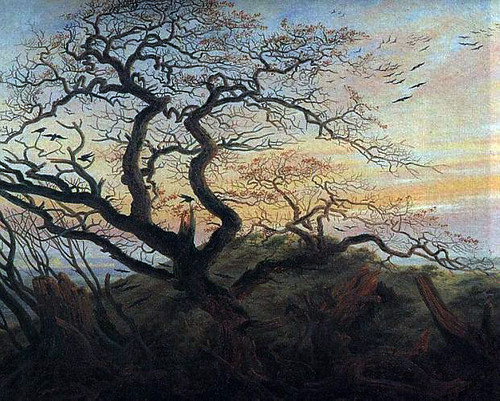
I'm nearsighted. I got my first pair of glasses at age 22. It was a late winter afternoon, and I remember walking out to the parking lot afterwards and standing slackjawed, wrapped up in the intricate patterns created by bare tree branches against the gloaming sky. It's a Caspar David Friedrich mood, something I hadn't been able to perceive clearly for years, my eyes steadily degrading under the influence of AutoCAD.

There's got to be a whole thread in art history tracking changes in the representation of trees. Tree drawings have a unique place at the overlap of cultural convention, technique, and perception. Gothic trees are either cartooned icons or diagrammatic trees-of-life. 18th century British landscape trees are brown and puffy, like drifting clouds of coalsmoke. The interlaced branching in Celtic art, with crossings alternating over and under each other, might be the first algorithmic tree drawings.

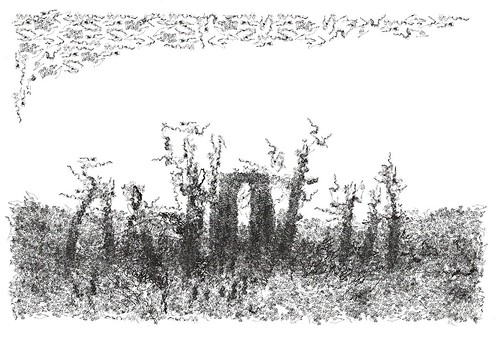
This fork of the thread resurfaces in the fractal trees of 90s computer art, and the fascination, in complexity and chaos theory, with intricate systems built from simple, iterated rules. A city is not a tree, but a tree is not a fractal. In a rule-based system, there's often the question of how to admit variation, in scripting this can come from a call to the random() class, which is actually pseudorandom: a seed number taken from a query to the system clock, then run through a bunch of messy math. Random input is also available from natural or stochastic processes: cosmic rays, vacum tube static, or in the case of Rod McLaren's excellent series of drawings done on the tube: the bumps and lurches of a 140 year old underground public transit network. Rod has composed fragments of his tube drawings into a version of Friedrich's Ruined Abbey Among the Oak Trees:
In general, the problem of tree drawing is this: how to reproduce an intricately complex object without resorting to convention. The problem speaks directly to the perception of pattern and the perception of noise, and the representation of either or both with media-specific techniques. Nobody wants to sit there and draw every branch, but how do you break it down without being reductive? And how do you avoid the double traps of reliance on technique and/or cliche?

These issues, (along with figure vs. ground, shapes vs. lines, shapes vs. patterns, etc.) come up in a series of drawings I've been working on and off with over the last few years. Process-wise, it started with this photo of winter branches silhouetted against an even grey sky:

Fascinated by the shapes, and wanting to know more about how they were put together, I dialled up the contrast and started playing around in photoshop. Composing by removing: I sliced away pieces of the pattern to leave behind figures that had a kind of scaleless abstraction, with indistinct boundaries:

This is all just trying to track down and isolate the qualities that made me want to snap the photo in the first place, a kind of interrogation of the image to find out why it was attractive and interesting: how much could be removed and manipulated without losing the life of it? (disclaimer: I am aware of, and somewhat disturbed by, the overtones of that last sentence, but we'll let it stand as a fair statement of intent for now)
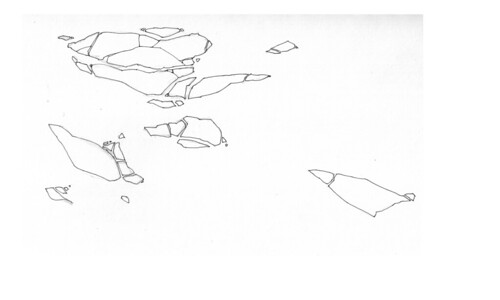
Drawing the pieces left over, the problem is the detail level: which specific bumps and divots can be glossed over, and which are necessary for the reading of the shape as a whole, and of it's relations to the other shapes? This is like the classic fractal problem proposed by Benoit Mandelbrot: how long is the coastline of England? The answer depends entirely on how long a ruler you've got:
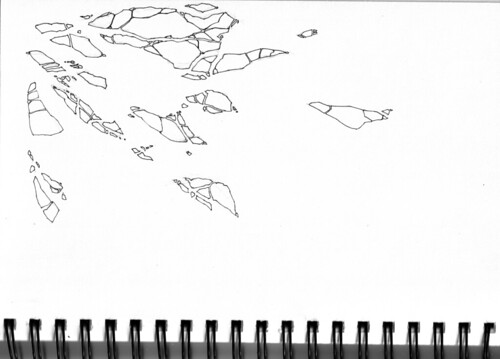
A more detailed version of the same composition, here I realized another problem: I was starting from the shapes instead of starting from the lines. This was forcing decisions about the detail level into a prematurely early phase of the process. If the whole set of steps that make the drawing could be reordered, the means of representation would more closely mirror the means of production in the orignal tree: 'fat lines -> medium lines -> thin lines' is an isomorphism of 'trunk -> branch -> stem':

So there's a shift in perception: the shapes aren't primary, they're just the spaces between the lines, the lines have a texture at their edges that shape the spaces, and they are broken down loosely into hierarchies and sub-hierarchies. This opens up the territory and the process, stop at any point and explore any area, and it should all still make sense:
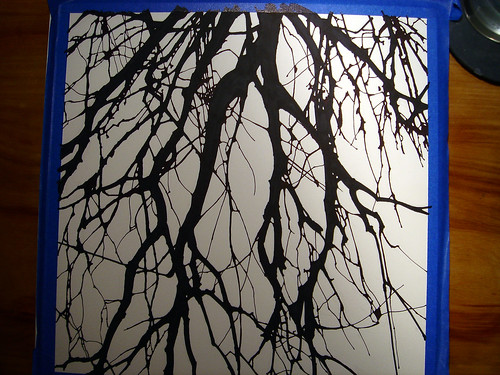
So that's what I did, drawing the fattest lines with a big marker, the smaller lines with a thin sharpie, and the tiniest lines with a fine gel pen. The drawing becomes diverse in time and in space, and exploring pieces of it with a camera is interesting while it's being worked, maybe more interesting than the final piece, maybe interesting enough to branch off into still other projects:

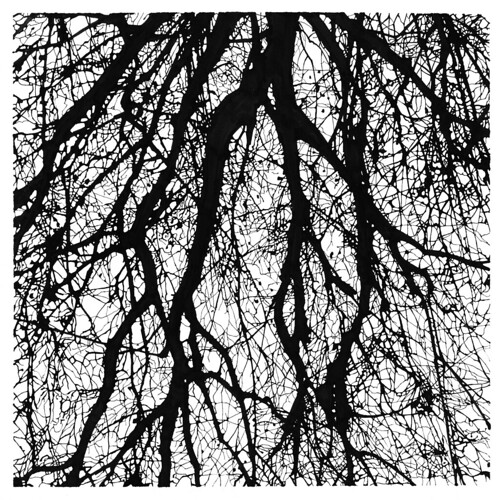
The biggest piece took about 50 or 60 hours to finish, it's the most time I've ever invested in a single drawing, and I think it was the way in which the landscape of the page kept changing that kept my interest. This started out as an exercise in learned pattern-making, the idea being that to analyze the method of production would be to acquire the use of that method, adding it the repretoire and using it later without a direct model, freestyling a tree, or tree-like thing based on the same rules. But the commitment to direct observation was also, in the end, productive. Some of the most interesting things were the bits that didn't fit the diagram, the coincidences that couldn't be planned, that would be edited out of a more orderly thing, the unexpected and the strange:


115 comments:
you might like http://www.inthedryer.com/treecolors/ - they had a series of white-on-black tree shirts too, but it ran out (partly thanks to me).
Good stuff.
A Jungian therapist I once went to out of curiosity held that how one draws a tree shows a good deal about how one thinks...
Great article Martin.
Hot sale Cheap cell phonesand cell phone china on our site! Fashion look and powerful functions for these mobile phones even discount cell phones! Wholesale HiPhone, 3G cell phones, PDA/Smart Phone now.China Cell PhonesDon't miss these cellphone!toys
Greetings everyone!
I came over in order to let you know that today, I have realized some new stuff, all thanks to you and your magnificent column.
Regards
Blogs are so informative where we get lots of information on any topic. Nice job keep it up!!
Régis Marcon est un grand Monsieur, abordable et simple. Un chef comme je les aime et que j'ai eu l' occasion de rencontrer à St Bonnet le Froid. Un excellent souvenir
Nice blog, its great article! …informative post, thanks for sharing it. Thanks for the information!
Hi, well be sensible, well-all described
Cool post.Nice creativity.very interesting blog.Thanks for sharing!!
The best personalised gift shop on the web.We provide great wedding gitfs,birthday gifts,anniversary gift,christmas gifts and unique gift idea for women,men,children and baby.
wow great i have read many articles about this topic and everytime i learn something new i dont think it will ever stop always new info , Thanks for all of your hard work!
fap turbo review
wow great i have read many articles about this topic and everytime i learn something new i dont think it will ever stop always new info , Thanks for all of your hard work
Nice work on putting together a very interesting post. Fabulous ideas and very helpful information. Well thought out and well written.
Where is your contact info?
The drawing of a tree is very different idea. Everyone has their own opinion about the trees. But this is really a great that you has expresses. Great thoughts, thanks for sharing.
With great pleasure I read your blog. The information is very interesting. my gratitude to you.
Great
loved it, will be waiting for your future posts
Thank you for sharing
Nice. i really love trees.All natural ingredients are included in semenax & virility ex.
I am thoroughly convinced in this said post. I am currently searching for ways in which I could enhance my knowledge in this said topic you have posted here. It does help me a lot knowing that you have shared this information here freely. I love the way the people here interact and shared their opinions too. I would love to track your future posts pertaining to the said topic we are able to read.
The website aims at providing scalable business-to-business and business-to-customers e-commerce solutions like e-marketplaces, online auctions, e-retail and e-procurement.
great post very interersting and informative, keep up the good work
love the article martin, keep up the good work
Great tips, I would like to join your blog anyway,
Nice work, I would like to read your blog every day Thanks
Really great post, Thank you for sharing This knowledge.
Very interesting post, extemely well thought out and put together. Keep up the good work.
I can see that you are facinated with tree branches like me. I love to watch an apple tree in my garden through its seasonal changes. Hopefully I will be able to see it bloom pink flowers again.
Heard about this site from my friend. He pointed me here and told me I’d find what I need. He was right! I got all the questions I had, answered. Didn’t even take long to find it. Love the fact that you made it so easy for people like me.
Hey,
I always finds drawings of trees eerie and somehow calming.
I wonder what that says about my personality?
Hi, I would just like to point out that I find this article very informative and would like to thank you for sharing your point of view.
Really great post, Thank you for sharing This knowledge.Excellently written article, if only all bloggers offered the same level of content as you, the internet would be a much better place. Please keep it up!
I wanted to thank you for this great post!!! I definitely enjoying every little bit of it I have you bookmarked to check out new stuff you post.
Your opening statement about getting glasses reminded me of my experience when I was 12. I tried on a friend's pair and I was blown away by how clear the world looked. I felt like I'd been looking through wax paper up til then.
I love your work - reminds me of fractals.
This is really great post..I love this pictures and all branching effects..nice work.
Beautiful images. I love the silhouettes of trees. Particularly since I moved from the east coast to the desert southwest and now we have silhouettes of cactus instead (which are actually very impressive).
all medicine online
I really appreciate your work , i must say that don't allow spammers who just spoil blog status...
There are may person searching about that now they will find enough resources by your post,
The Zune concentrates on being a Portable Media Player. Not a web browser. Not a game machine. Maybe in the future it’ll do even better in those areas, but for now it’s a fantastic way to organize and listen to your music and videos, and is without peer in that regard. The iPod’s strengths are its web browsing and apps. If those sound more compelling, perhaps it is your best choice.
Hey really cool bro , you did great job bro keep it up.
wartrol
acnezine
Wahh.. Makasih Info nya kk ^_^
Its really seem cool , because i like the moving branching in the air :)
idol white | revitol hair removal cream
its cool branching i really love it :)
barkoff review | nubrilliance reviews
Its really seem cool , because i like the moving branching in the air :)
french bistro chairs
Thanks Martin
Amazing designs, I really like the one that changes into a three and then into a triangle, just incredible. Thanks!
Nice job keep it up!!
great info
Excellent write up with quality content and style of writing. We’ve understand your stuff previous to and you’re just too magnificent. I actually like what you could have acquired here, really like what that you are saying and exactly how in which you say it. You are making it enjoyable therefore you still care for to hold it smart. I cant wait to see a lot more within you. This is really going to be a great web page with thousands of dedicated readers. Special word of appreciation from Venapro & Purchase Venapro Review Team.
Excellent write up with quality content and style of writing. We’ve understand your stuff previous to and you’re just too magnificent. I actually like what you could have acquired here, really like what that you are saying and exactly how in which you say it. You are making it enjoyable therefore you still care for to hold it smart. I cant wait to see a lot more within you. This is really going to be a great web page with thousands of dedicated readers. Special word of appreciation from Venapro & Purchase Venapro Review Team.
I have been following all Google logos and no one among them has never caught my eyes. I like their simplicity in creating their homepage, by I enjoy most their logos.
SEO services India are gaining popularity and Asha Infotech, a renowned company offering web and print media solutions and seo services India are cashing in on this opportunity. With highly skilled SEO experts at Asha Infotech, you can be assured of our SEO services in India.
ShivaGuide.com is an online portal offering information and services on the Jewish tradition of sitting Shiva. It is a useful guide for mourners during and after the Jewish funeral.
Call us if you want to feel something you probably haven't felt in a while- Hope. The decision to file bankruptcy lawyer new york has important benefits. And it may be your best option. Bankruptcy Is Not A Dirty Word.
You opened a new world of art to me today. Your tree drawings are absolutely amazing and incredibly life-like. Thank you for sharing them.
Yeah man you did Branching briefing very well , I highly appreciate your effort :) Must check it out proactiv reviews | silk n sensepil reviews for more details
One must thing i wanna share here to all out there , don't cut down tree branching , those are really out future assurance.
zetaclear | african mango
Its quite like cool , when branching are fly in he air & wind blow out , its look na ?
provillus | breast actives
When first time i saw your blog , i was remember my previous lovely moments which you revise me thanks for that , topic about branching is too gud.
hydrolyze reviews | procera avh
Its gonna be cool article whatever you shared , I love it , today I become your fan :)
sensa reviews | hydroxycut reviews
I really like the moving pictures. Nice blog post. Thanks you for sharing.
Great to know the -- in depth from this blog.This will really help for my forward steps to be taken.
kissimmee vacation rentals
Vänligen en mer inlägg om det .. jag behöver den här artikeln för att slutföra mitt uppdrag i kollegiet, och den har samma tema med din artikel. Tack, bra aktie.
Yeah I know that is only branch which support whole tree , same as that a man who support another mankind..:)
Smith Carter
buy breast actives | buy zetaclear
Branching made any part of life & tree live more strongly for long lasting that's why I love to read branching article.
Alex Daniel
provillus for men | african mango plus
Yeah I love the way that branching have been exposed by you , there was cool stuff that you shared !!!
Kevin Jason
sensa reviews | prosvent
yeah branching attached their childs together with them like as a mother totally care her child like a branch.
Alex Kevin
shake weight for men review | nono hair removal reviews
Now please do heaven, that list is hilarious! I was once a NOOB but since have started taking health supplements to straighten out.
Yes that's good feel to see free branching moving in the air.
Johnny Bravo
San Diego , USA
zetaclear reviews | provillus reviews
Your imaginary thoughts make it great.
Yeah I know what you talking about , I love the branching & its important feature :)
Jenny Lovis
Washington DC ,USA
does sensa work | breast actives reviews
Very worthwhile piece of writing, thank you for the post.
Pretty effective data, thanks for the article.
Thank you for the post, pretty helpful info.
You did awesome job , I like the way that you customize pics in your articles :)
John Botta
San Diego ,USA
sensa reviews | does the shake weight work
That's look pretty cool & you did shared also cool pics of branching :)
Merry Johnny
birmingham ,UK
xenadrine reviews | african mango scam
The animation was cool.. The photos are really stunning.. Thanks for sharing.. :)
procera AVH | OPC Factor
well branching is pretty cool topic to discuss many things , Yes obviously there are many benefits & disadvantages of branching that all peoples shouldn't know..
Merry Johnny
Birmingham ,UK
hydrolyze | hydroxatone reviews
Nice post! I love trees and nature overall.
Roger
Virility EX
Nespresso Pixie
Great work, thanx for sharing. This is getting one if my favourite blogs!
Great post!! thanks for sharing!~
Amazing photograph nature photographs are always attract me it give some kind of relaxation thanks for sharing those photographs
Drug Store
Thanks for sharing.
Great post thanks for the share!
Hello,
This is an interesting information.... keep updating your blog. Thanks for the share....
Awesome Post. highly useful, Thank you so much for sharing it with all.
Round Rock Remodeling Company
I really love the way you discuss this kind of topic
recortar siluetas
This is great! Thank You so much for sharing this valuable list. It will help me out greatly.
Thanks very good post. is very important for my SEO.
This is great! Thank You so much for sharing this valuable list. It will help me out greatly.
Thanx for that list, you are right, these kind of information is normaly sold…
Thanks very good post. It is very important for my SEO.
Great post. thanks for sharing post. its a really usefull list. good work.
I really love to read articles that have good information and ideas to share to each reader. I hope to read more from you guys and continue that good work that is really inspiring to us.
I found this is an informative and interesting post. I think it is very useful and knowledgeable. I would like to thank you for the efforts you have made in writing this article. I am hoping the same best work from you in the future as well.
Thank you for sharing to us.there are many person searching about that now they will find enough resources by your post.I would like to join your blog anyway so please continue sharing with us
The best part about trees is the patterns they create. I believe the Virility Ex of the pattern explains the in workings of a persons mind once drawn
it was looking so nice to see such type of branches.. keep it up... Passing a Kidney Stones
Your Escort Agency offers exclusive and most beautiful London escort girls of various nationalities.
Your Mademoiselle escorts agency is select the most charming, friendly and the finest London escorts for our Escort gallery and provide the best escort services in London.
I love branching & always look forward for learn about branch...
Steve Austin
Leeds ,UK
african mango scam & hgh energizer
I love to study about branch & their aspect :)
Steve Austin
Washington ,DC
acnezine & sensa reviews
I love branching & their all aspects , Because i'm biologist :)
Steve Austin
Washington ,DC
alteril & genf20 plus
I been browsing through different sites each day and yours is an interesting one. We may differ in beliefs and interest but I surely could relate in your way of writing. I’m looking forward to read and as well as share some knowledgeable information with you soon.
I admire the way you express yourself through writing. Your post is such a refreshing one to read. This is such an interesting and informative article to share with others. Keep up the good work and more power. Thanks!
yeah love to cutting down branches ahahaha.
William Joshua
Washington ,DC
natural gain plus reviews & enhancexl reviews
Well, I do not really imagine it is likely to have effect.
Superb work! The data supplied was very useful. I hope that you maintain the good work accomplished.
Great Stuff, enjoyed reading about branching very much.
buy omnitropin
Actually I wanna adding a simple point regards branching , Branch is the most important part of tree :)
William Joshua
Washington ,DC
nono hair removal reviews & shake weight for men review
Nice post! Thanks for sharing!
I only here just because I'm internet newbie , I wanna make more friend by your blog interaction !!!
Hayden Bryan
NEW YORK City
caralluma actives & semenax
Post a Comment