Friday, August 06, 2010

Elastic Centroids


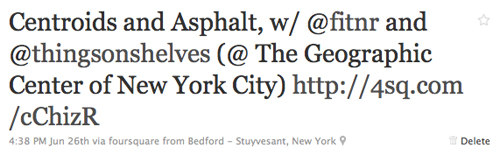
Back at the end of June, I visited the geographic center of New York City. It's a pleasant spot, under the elevated portion of the J. The summertime afternoon light filters down, and bounces off the brightly colored signs and storefronts that line the long run of Broadway. Right at the corner, there's a classic Fenced Lot.

centroids


If you need an excuse to see it for yourself, here's a good one: it's part of Neil Freeman's Centroids and Asphalt, created for the Elastic City series of walks. Freeman's work, often with GIS and graphics software, is generated from the difficult-to-see geographic, historic, and material data that compose the structures and streets of cities. The large scale patterns and forms that Freeman finds here are somehow comfortingly familiar and displacingly beautiful at the same time.


(All Streets, Centered, Chicago, by Neil Freeman)


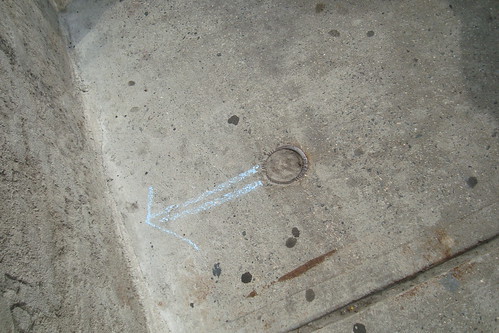
Neil's walk integrates these same concerns: material flow, plant and animal life, social history, and organizational geometry - all in real world terms, all within a few blocks of central Brooklyn.

DSC09225


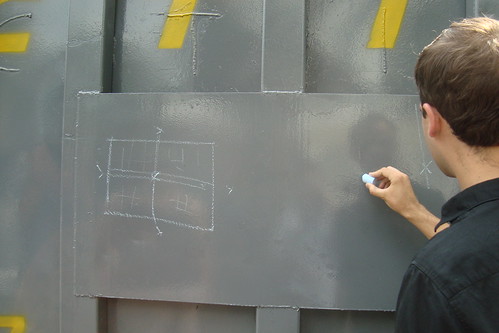
The best thing about this exploration is that it's conducted *with* the walk's participants, rather than *to* them. A session in front of a rowhouse, listing the inputs and outputs of one specific building, had us all speculating about the difference between a private monopoly and a public utility, privileges and rights, discrete deliveries and continuous flows ...

As Elastic City's founder, Todd Shalom, says in this interview with Neil and Urban Omnibus:

"Walking tours bore me– that’s what podcasts are for. In contrast to traditional walking tours, which seem to re-tell somebody’s or some group’s past experience through data and facts, Elastic City walks strive for a more embodied experience in the present moment. These walks offer to widen the perspectives for participants."

DSC09230


Neil's walk will be held a few more times throughout the end of the summer. There's one tomorrow.

Monday, August 02, 2010

Some Notes


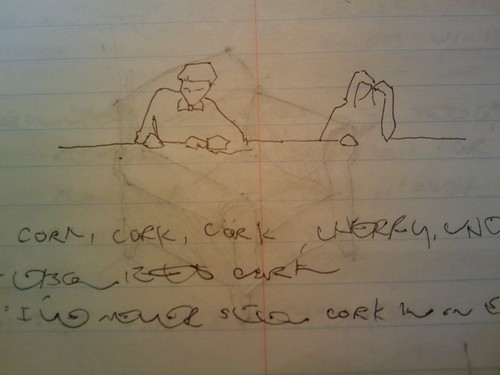
2010-08-02 16.18.20, originally uploaded by ske765book.

More with less: managerial and visionary expertise to examine existing inventories, find efficiencies, and build consensus around reconfiguration.

We like cheap because we like the aesthetics of efficiency.

Moving between disciplines requires a special kind of work in translation and metaphor.

Small and/or weird, and/or free

“Kill the brand, transfer the equity.”

Using default , conservative language to reinforce search engine results, talking to machines, not humans.

“In the bubble”

“Actionable”

“Mission Driven”

Show us what we are and we tell you it’s wrong, we want to be seen as the kind of thing that we aspire to.

Show us who we think we are (Show us what we want to be).

Means over Ends: We draw something that looks cool, without remembering that it looks cool because it’s rare, and it’s rare because it’s expensive. When the time comes to figure out the implementation, we talk ourselves out of it because of the expense and difficulty.

In house labor is cheaper than field labor.

“This is unique, this is a parking garage in Kansas City.” “Do you like it?” “Yeah, it’s different.”

Different variation of a theme: discrete elements hung on an abstract diagram. Switching back and forth between levels, accepting givens and then exploding them to modify them at a global level. No, exploding is different, exploding is “make unique”, embedding something in the world at the next lower level. Editing the rules is fundamentally different, jumping one level up. Model lines and symbolic lines, an overlay of cognition back onto perception. You need a limited reference space (with a scale, conventions, etc.) in order to create and manipulate *stuff*.

We present the big ideas and people either decide they like them or not, then we spend two hours talking about details and politics of parking or carpets or something.

“Slipping” in reference to a deadline implies the future is a pit, an event as something hanging on the edge, slipping down. An indefinite delay or cancellation as a bottomless drop, like falling up into the sky …

These projects generate collateral eddies and flows, that are sometimes tangential to the primary direction, and sometimes swell up and swamp the original vector.

“My favorite reports.”

Ancient Magical Invocation of Doom: “Okay, we’re done, all we have to do now is print.”

“That way we’re improving student life, which was our fourth priority! Oh wait, that’s our third priority, increasing storage space was our fourth.”

Object --> #^# <-- Field

Less new construction, more internal rearrangement – phasing, planning, and adaptive reuse.

Thinking Small.

“They don’t learn to be better designers, they learn to be better operators.”

“Openness to an open-ended process.”

Those moments in meetings where people say: “what do we do next?”