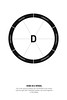
This is an open question: What is this fractal? It's a method for filling a 2D plane with circles in an orderly way - circles made of circles, all the way down. There are published examples of similar systems, like the Apollonian Gasket, the Kleinian Groups, Indra's Pearls, but I've never seen this particular arrangement before, and I've been looking for over ten years. Is this a trivial variation on something already known? Or a new and undiscovered thing? I have no idea. I found it while doodling in math class.
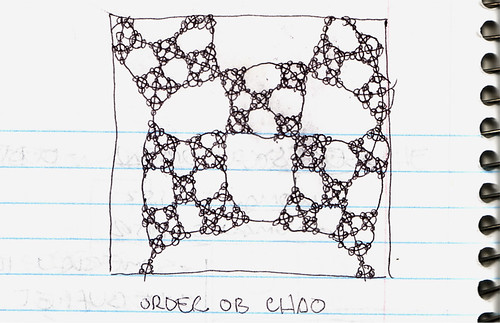
As a teenager in the 90s, my brain was warped and wrinkled by rave flyers, computer graphics, and pop science. I remember zooming in and out of the Julia Set on an Amiga 500 while still in middle school. In high school, these patterns were reinforced with heavy doses of techno music, Mondo 2000, and chaos theory. Hence the embarassing caption to the drawing above, which was made in college calculus class. At the University of Maryland, they wouldn't let anyone enter the architecture major without a B or higher in calculus. It took me three tries. If someone had sat me down and said "look, calculus is all about the always-imossible reconciliation between the grid and the curve, a constant becoming that has to get infinitismally small before its realization," then, I might've got it the first time round.

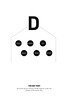
When the architecture faculty introduced us to Autocad, one of the first things I did with it was to try drawing this thing accurately. The basic rule is to draw a circle around every intersection, which creates four more intersections, and so four more circles, always smaller than the last round. What I couldn't figure out in sketchbooks was whether or not the space left over would be circular too, and whether the centers of the circles were really precisely at the intersections, or shifted slightly. These questions were related - shifting the centers made for circular voids, but I couldn't decide if that was breaking too many rules, or if the whole thing really hung together like it seemed to.

The trick that made it work was an inversion - in Autocad, it's impossible to draw the filled circles around the intersections first, without knowing where the centers really are, but it's possible to draw the voids first and work backwards from there. One of Autocad's many methods for drawing circles is as a three point snap. For any three points, there is one and only one circle that hits all of them - circumcircles, again. And luckily, one of the Object Snap (OSNAP!) settings is tangent to a curve; this means that you can easily draw a circle that's tangent to three other curves, without doing the math. Not that this drawing was easy, the image at the head of this post is a print from a .dwg with over 10,000 objects, the iterations are 9 levels deep.

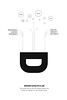
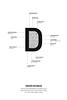
This view of a hand drawn version shows the two types of circles, filled and void. The whole pattern could be made from either all filled, or all empty; the other kind is emergent from the constant reiteration of the one. The trick of drafting the thing by hand is again all about finding the right tools, and then reckoning. For the larger circles here, I improvised with a thumbtack and a piece of wire, the intermediate were drawn with a compass, the smaller were done with a circle template (always tricky to find one at the right radius), and the very smallest were filled in freehand.
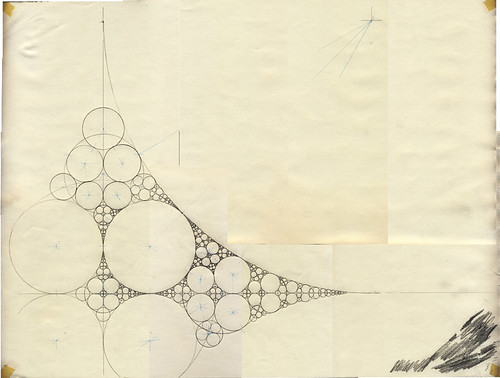
The hardest part of building the thing by hand is to find a center and a radius that will hit all of the adjacent circles at a tangent. In these drawings, I'm trying again and again to find some kind of geometric or proportional rule that will locate the next center point, and while there were a few promising patterns at the larger scale, they all broke down eventually, leaving trial and error as the only way through, but stll it works. That's why this is partially a plea to anyone else who might have more quantitative information about these geometries: help put this in context. What kind of thing is it?

(for more process drawings, click here)